

Empowering 5G Open RAN with AEWIN’s Flexible and Scalable Network Appliance
Introduction
The deployment of 5G networks is transforming the telecommunications landscape, enabling faster speeds, lower latency, and greater connectivity. Open RAN architecture is revolutionizing the 5G landscape by promoting interoperability, flexibility, and cost efficiency. AEWIN designed robust and scalable network appliances to meet the demanding requirements of modern 5G infrastructure. In this blog, we will explore how AEWIN delivers a high-performance 5G Open RAN solution with its networking appliance supporting self-designed networking modules and industry-standard acceleration cards.
5G Open RAN Solution
AEWIN performance network appliance, SCB-1947, has been selected by our partner for building the 5G Open RAN Solution to support the construction of enterprise wireless private networks and campus Internet of Things for industrial transformation.
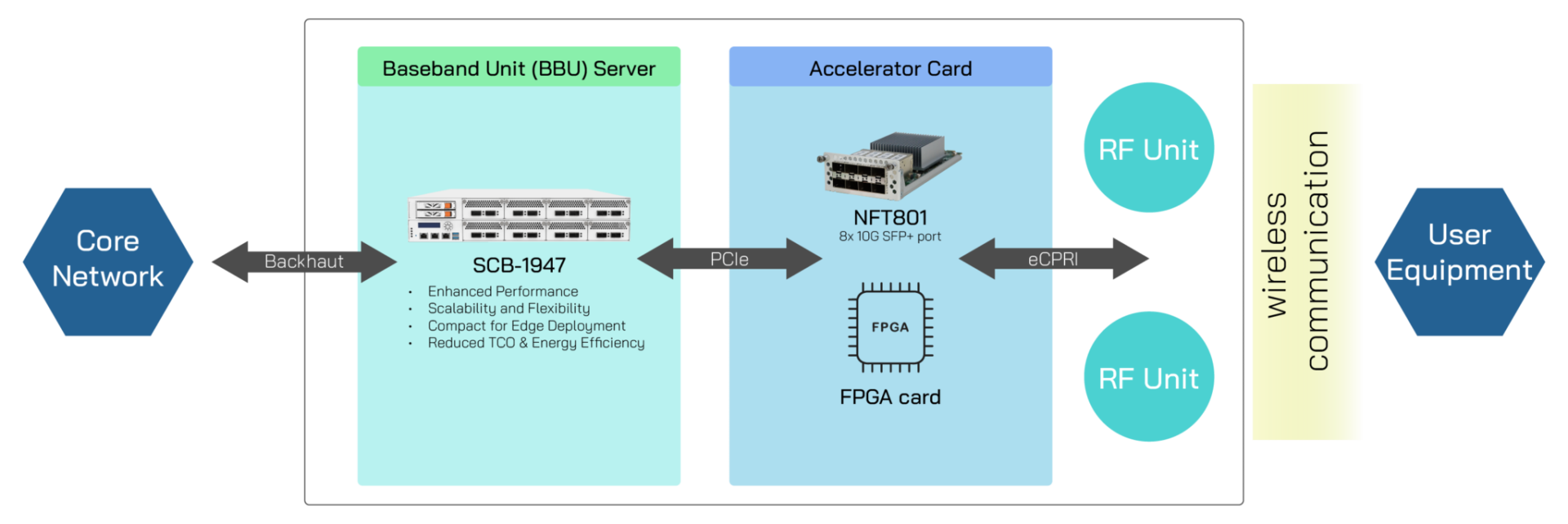
Image1. 5G Open RAN System diagram (NFT801 is an NIC supporting 8x 10G SFP+ port)
In this deployment, the SCB-1947 was integrated with an FPGA-based acceleration card and an AEWIN self-design NIC, NFT801 (8x 10G SFP+), to create a complete 5G small cell solution. The FPGA card assists in offloading compute-intensive tasks such as low-power forward error correction (FEC) and encryption, reducing CPU overhead and improving system efficiency while the networking module secure high-speed connectivity and low-latency communication.
Features of AEWIN SCB-1947-based solution are as below.
● Enhanced Performance: Equipped with advanced multi-core processors, AMD’s latest Siena Processor with up to 64 cores, the SCB-1947 delivers the computational power needed for real-time signal processing, data routing, and network management, which are critical for Open RAN architectures.
● Scalability and Flexibility: The modular design of the SCB-1947 allowed the customer to effortlessly scale up by integrating FPGA cards and high throughput NICs. With the support of PCIe Gen5 slots, it not only boosts performance but also ensure seamless compatibility with multi-vendor components.
● Compact for Edge Deployment: Despite the excellent scalability of the SCB-1947 platform, it does not compensate for its size. AEWIN designs it with 2U form factor and short depth of 600mm which makes it suitable for small cell deployments in space-constrained environments.
● Reduced TCO & Energy Efficiency: The power-efficient AMD Siena processor enables lower power consumption while maintaining high performance, reducing both energy costs and operational expenses. Additionally, AEWIN’s self-designed networking module provides cost-effective, high-speed connectivity while ensuring hardware flexibility, further optimizing total cost of ownership (TCO).
Summary
AEWIN’s SCB-1947 network appliance provides a powerful and flexible foundation for 5G Open RAN deployments. It features the performance, flexibility, and scalability needed to meet the demands of modern 5G networks. By integrating with industry-standard acceleration cards and networking modules, the SCB-1947 solutions help our partners to unlock the full potential of 5G Open RAN.