

2025.03.12

Introduction to Modern Threat Detection and Response: EDR, NDR, XDR, and MDR

Share:

Introduction
In the evolving landscape of cybersecurity, organizations face an increasing number of sophisticated threats targeting their digital infrastructure. To deal with these challenges, there are various detection and response solutions including EDR, NDR, XDR, and MDR. This blog delves into the unique capabilities and benefits of each solution, offering insights into their roles in modern cybersecurity strategies.

Diverse Detection and Response Solutions
MDR-02-1536x831

  • EDR (Endpoint Detection and Response)
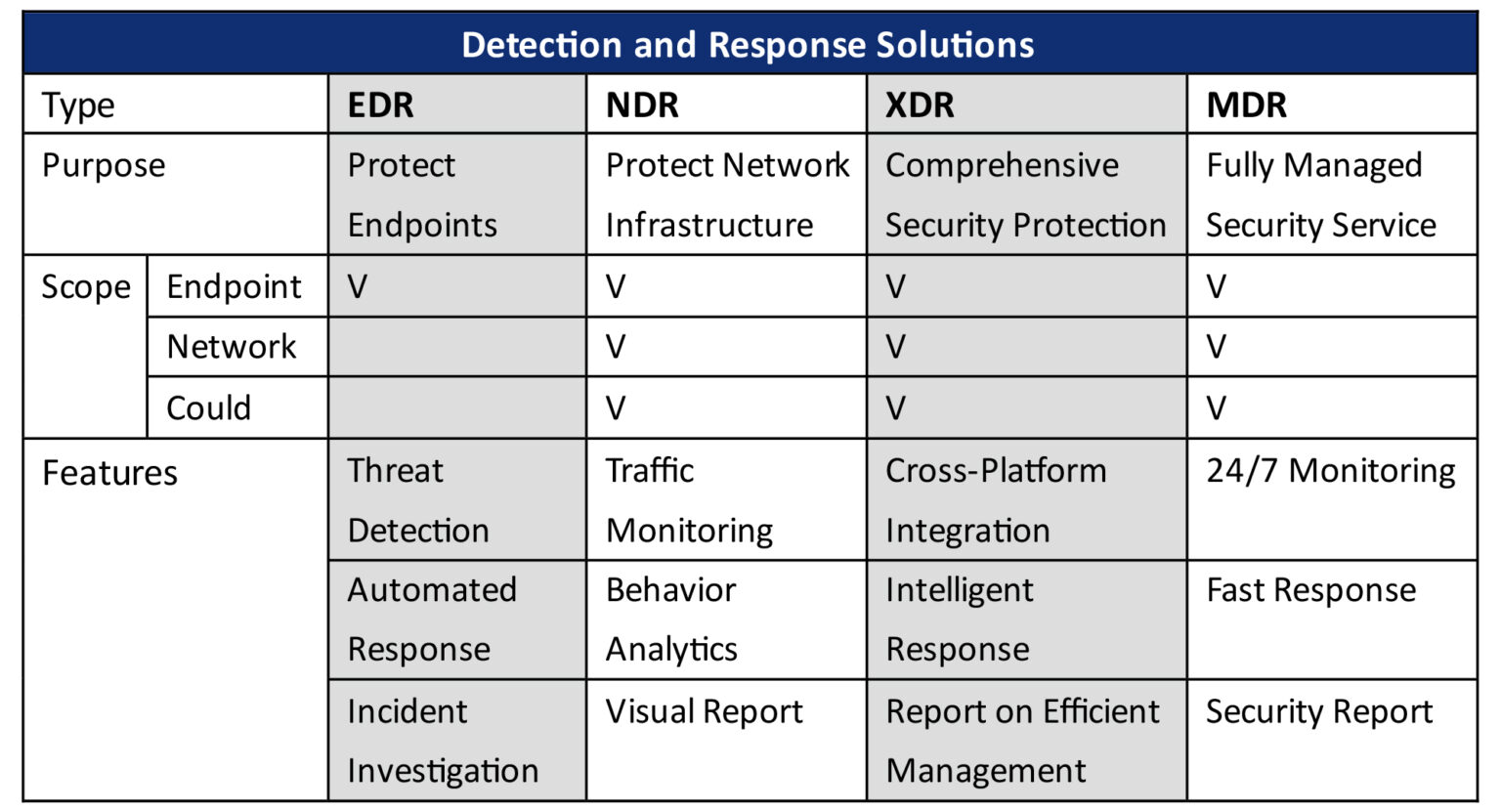
    Focusing on safeguarding endpoint devices including servers, computers, and mobile devices, EDR surpasses traditional antivirus solutions by providing advanced features like real-time incident analysis and threat hunting for effective detection of suspicious behaviors even for unknown threats. Automated responses include compromised endpoints isolation and malicious processes termination for robust endpoint security.
  • NDR (Network Detection and Response)
    NDR specializes in monitoring and analyzing network data and traffic to identify threats including unauthorized access and malicious activity. With its ability to detect threats in real time, NDR plays a critical role in securing network infrastructures against both external and internal attacks. Its’ traffic monitoring and behavior analytics capabilities provide a proactive approach to network defense.
  • XDR (Extended Detection and Response)
    Unifying multiple security tools into a single platform, XDR delivers centralized visibility and automated responses across the overall infrastructure of organization. By integrating data from endpoints, networks, and cloud environments, XDR can address complex, multi-layered attacks. Its cross-platform integration and intelligent response features enable efficient threat management and mitigation.
  • MDR (Managed Detection and Response)
    MDR is a security service for detection and response. By outsourcing detection and response efforts to MDR providers, organizations can focus on their core business operations while maintaining strong cybersecurity defenses. MDR delivers 24/7 monitoring, fast response, and detailed security reports, making it an ideal solution for organizations lacking in-house expertise.

Summary
The modern threat landscape demands effective approaches to cybersecurity. EDR, NDR, XDR, and MDR each serve unique roles with specific strengths suited for different scenarios. Organizations can flexibly combine these solutions based on their needs to enhance threat detection, analysis, and response, providing a more comprehensive and adaptive cybersecurity strategy.


Related News

Building AI-Ready Cybersecurity Infrastructure
2026.10.07

Building AI-Ready Cybersecurity Infrastructure

As cyber threats grow increasingly sophisticated, modern security infrastructure relies heavily on AI to analyze massive traffic volumes and accelerate real-time threat response. Powered by Intel Xeon 6 processors, AEWIN servers and network appliances deliver high-performance computing, efficient AI acceleration, and robust, hardware-based security required for demanding workloads across on-premises AI and AI-powered cybersecurity environments.

AEWIN 2025 Sustainability Report Highlights
2026.09.29

AEWIN 2025 Sustainability Report Highlights

At AEWIN, sustainability is integrated into corporate management with a focus on environmental responsibility, employee well-being, and social engagement. The 2025 Sustainability Report highlights the company’s continued efforts to improve resource efficiency, strengthen workplace health management, and foster a culture where sustainability becomes part of everyday actions.

Architecting Rack-Scale AI Infrastructure for the Neocloud Era
2026.09.24

Architecting Rack-Scale AI Infrastructure for the Neocloud Era

Generative and agentic AI applications, coupled with intensifying training and inference workloads, demand unprecedented compute throughput, memory, networking, and storage. Consequently, infrastructure can no longer be designed around isolated servers. The rise of specialized Neocloud providers further accelerates this shift toward rack-scale architecture, where compute, networking, and thermal management must converge to yield efficient, adaptable AI capacity.

Inquiry Cart

total 0 items

Compare

total 0 items

Email Subscribe

Verification

Click the numbers from smallest to largest.

We use cookies to allow our website to work properly, personalize content and advertising, provide social media features and analyze traffic. We also share information about your use of our site with our social media, advertising and analytics partners

Manage Cookies

Privacy Settings

We use cookies to allow our website to work properly, personalize content and advertising, provide social media features and analyze traffic. We also share information about your use of our site with our social media, advertising and analytics partners

Privacy Policy

Manage Consent Settings

Essential Cookies

Accept All

The website cannot function without these cookies and you cannot switch them off on your system.

These cookies are typically set only in response to an action you perform (i.e. a service request), such as setting privacy preferences, logging in, or filling in a form.

You can set your browser to block or prompt you for these cookies, but this may prevent some site features from working.

Function Cookies

These cookies enable the provision of enhanced functionality and personalised content, such as videos and live chats.

Settings can be made by us or by third-party providers whose services we have added to our pages.

If you do not allow these cookies, some or all of our features may not work properly.

Marketing Cookies

Marketing cookies are used to track visitors' journey through our website. The purpose is to display advertisements that are relevant or appealing to the individual user and are therefore more important to the publisher or third-party advertiser.

Targeting Cookies
These cookies are set through our site by advertising partners. These companies may use cookies to build a profile of your interests and show you relevant adverts on other sites. They only need to recognise your browser and device to work. If you do not allow these cookies, you will not experience targeted advertising across different websites.

Social Media Cookies
These cookies are set by a range of social media services that we have added to our site to enable you to share our content with your friends and networks. They can track your browser across other websites and build a profile of your interests. This may affect the content and messages you view when you visit other websites. If you do not allow these cookies, you may not be able to use or view these sharing tools.