

2025.11.14

Scalable DDR5 Memory Solutions for Network Appliances and Servers

Share:

Introduction
Introduced in the late 1990s, Synchronous DRAM (SDRAM) revolutionized computer performance by replacing earlier asynchronous DRAM designs. System memory (RAM) acts as the temporary workspace between processors and storage devices (SSDs or HDDs) and increasing its bandwidth and capacity has long been one of the most effective ways to boost computing performance.

DRAM Trend and Current Market Overview
Double Data Rate (DDR) SDRAM , introduced around 2000, doubled data transfer rates by transmitting data on both the rising and falling edges of the clock signal. Each subsequent generation—DDR2 through DDR4—brought continuous improvements in speed, power efficiency, and reliability.

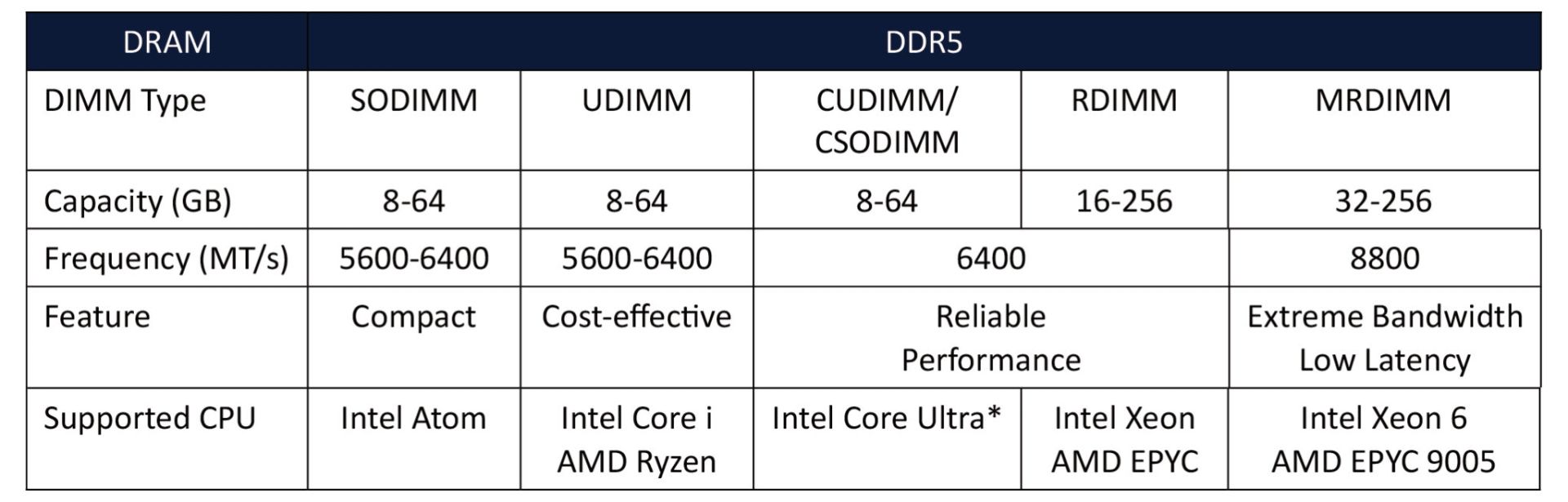
Today, as global IT demand and AI infrastructure expands rapidly, memory manufacturers are prioritizing high-performance DRAM like DDR5, driving platform upgrades across data centers and networking systems. The following table summarizes the main DDR5 memory types currently used in servers and network appliances:
ALL_news_tech_blog_26A13_oCGFnmtHCf

*Intel Core Ultra supports 6400 MT/s while Intel Core Processors support the same DIMM support with BIOS updates and 5600 MT/s limit due to the CPU spec.
**The spec and supported CPU may vary from time to time based on the current market.


  • SODIMM: Compact Memory for Space-Constrained Systems
    Small Outline DIMMs (SODIMMs) feature compact form factors ideal for embedded systems, industrial PCs, and compact network appliances. Roughly half the size of standard DIMMs, SODIMMs excel where space and thermal efficiency are critical.
  • UDIMM: Cost-Effective Memory for Consumer and SMB Applications
    Unbuffered DIMMs (UDIMMs) connect directly to the CPU’s memory controller to reduce latency and cost. They are suitable for general-purpose computing in consumer PCs and SMB environments.
  • CUDIMMStable High-Speed Memory for Edge Systems
    As AI-driven workloads push memory speeds higher, signal integrity issues like jitter and EMI become challenges. Clocked UDIMMs (CUDIMM) and Clocked SODIMMs (CSODIMM) integrate a Client Clock Driver (CKD) to improve signal integrity for enhanced stability and performance at higher frequencies.
  • RDIMM:Reliable and Scalable Memory for Enterprise Servers
    Registered DIMMs (RDIMMs) include a register buffer that stabilizes signal transmission between the memory controller and DRAM modules. This architecture reduces electrical load on the CPU and enhances stability which is critical for servers and workstations that run continuously under heavy loads.
  • MRDIMM:Next-Generation High-Bandwidth Memory for Data Centers
    Multiplexed Rank DIMMs (MRDIMMs) represent the latest advancement in server memory. MRDIMM leverages multiple ranks within a single module to deliver higher bandwidth and capacity for AI, ML, and data-intensive analytics.

Conclusion
As data growth continues to surge, the computing ecosystem evolves with innovations in scalability, bandwidth, and efficiency. DRAM remains fundamental to system performance, and the evolution from DDR5 to next-generation memory architectures will power the future of AI and high-performance computing with superior speed, stability, and scalability.

Related News

Building Secure and Efficient On-Prem AI Infrastructure
2026.07.02

Building Secure and Efficient On-Prem AI Infrastructure

As Generative AI, AI Agents, and enterprise AI applications continue to expand, organizations are increasingly looking beyond the cloud to deploy AI closer to their data. Driven by growing concerns over data sovereignty, security, latency, and long-term operating costs, on-premises AI infrastructure has become a strategic choice for enterprises seeking greater control, performance, and scalability.

Rack-Scale AI Infrastructure: Maximizing Performance, Efficiency, and Scalability for the AI Era
2026.06.30

Rack-Scale AI Infrastructure: Maximizing Performance, Efficiency, and Scalability for the AI Era

Driven by the explosion of Gen AI, Agentic AI, and the massive datasets behind them, computing infrastructure is evolving from standalone servers to rack-scale architectures. Modern AI workloads require a tightly integrated combination of computing, networking, storage, and cooling solutions to deliver maximum performance and efficiency. Future-Ready AI Infrastructure has become the foundation for the AI Era.

Enhancing Network Resilience with AEWIN Gen4 LAN Bypass
2026.06.30

Enhancing Network Resilience with AEWIN Gen4 LAN Bypass

Traditional LAN bypass focuses on keeping traffic flowing when a system goes down, but modern deployments require greater flexibility to balance availability and security. AEWIN Gen4 LAN bypass builds on the Gen3 foundation by introducing enhanced traffic control mechanisms to enable network behavior to better align with real-world operational demands.

Inquiry Cart

total 0 items

Compare

total 0 items

Email Subscribe

Verification

Click the numbers from smallest to largest.

We use cookies to allow our website to work properly, personalize content and advertising, provide social media features and analyze traffic. We also share information about your use of our site with our social media, advertising and analytics partners

Manage Cookies

Privacy Settings

We use cookies to allow our website to work properly, personalize content and advertising, provide social media features and analyze traffic. We also share information about your use of our site with our social media, advertising and analytics partners

Privacy Policy

Manage Consent Settings

Essential Cookies

Accept All

The website cannot function without these cookies and you cannot switch them off on your system.

These cookies are typically set only in response to an action you perform (i.e. a service request), such as setting privacy preferences, logging in, or filling in a form.

You can set your browser to block or prompt you for these cookies, but this may prevent some site features from working.

Marketing Cookies

Marketing cookies are used to track visitors' journey through our website. The purpose is to display advertisements that are relevant or appealing to the individual user and are therefore more important to the publisher or third-party advertiser.

Targeting Cookies
These cookies are set through our site by advertising partners. These companies may use cookies to build a profile of your interests and show you relevant adverts on other sites. They only need to recognise your browser and device to work. If you do not allow these cookies, you will not experience targeted advertising across different websites.

Social Media Cookies
These cookies are set by a range of social media services that we have added to our site to enable you to share our content with your friends and networks. They can track your browser across other websites and build a profile of your interests. This may affect the content and messages you view when you visit other websites. If you do not allow these cookies, you may not be able to use or view these sharing tools.