

2025.07.23

Unlocking Scalable Memory Expansion with CXL AIC

Share:

Introduction
In today’s fast-paced digital landscape, innovative applications such as CDNs, real-time data analytics, and AI-driven threat detection are becoming increasingly memory-hungry to process and deliver data efficiently. However, expanding memory capacity in network appliances has traditionally been a significant challenge due to limitations in physical space, thermal design, and CPU resources. CXL emerges as a revolutionary solution, enabling memory expansion to overcome the limitations.

In this blog, we will explore how CXL introduces a new tier of memory, its advantages, and how it can be integrated into platforms such as AEWIN’s SCB-1953 powered by Intel Xeon 6 processor to boost performance for modern networking applications.

A New Tier of Memory
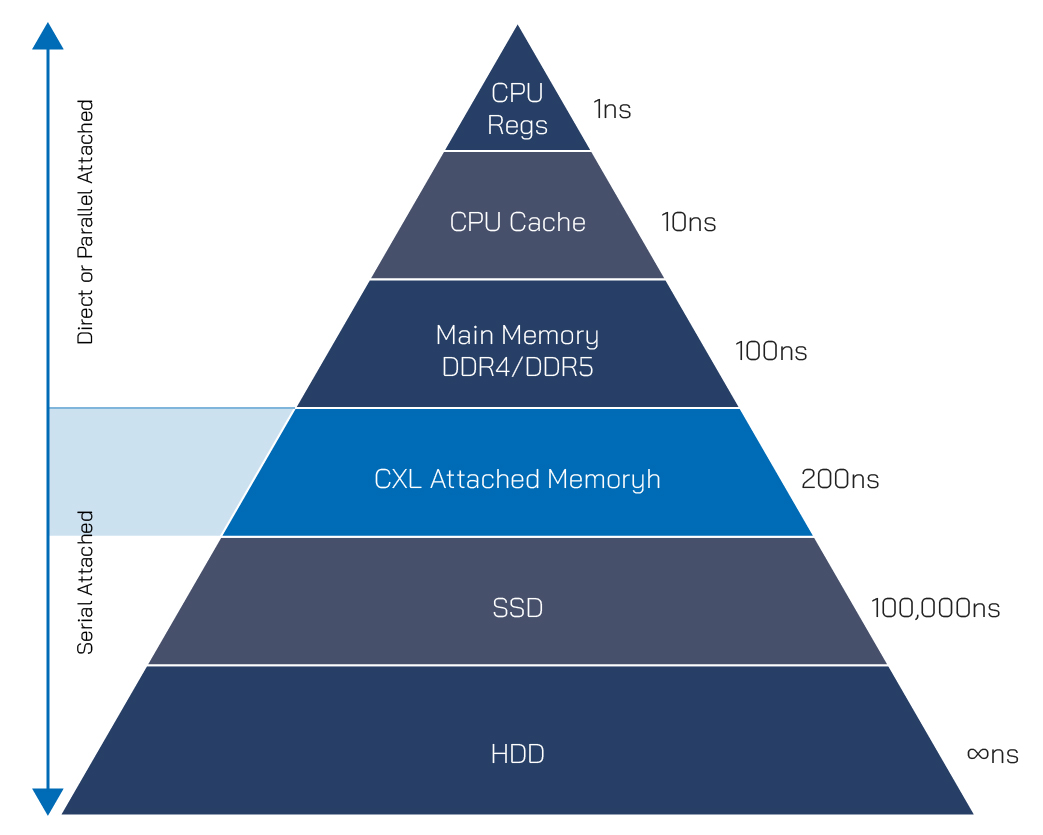
CXL is a high-speed interconnect technology that bridges the gap between traditional DRAM and slower storage solutions. CXL Type 3 devices, such as memory expanders can be installed as Add-in Cards (AIC) via PCIe Gen5 slots, offering high bandwidth and low latency in a cost-effective way.
ALL_news_tech_blog_26A13_Oyji03jGfQ

Advantages of CXL

1. Increased Memory Capacity:
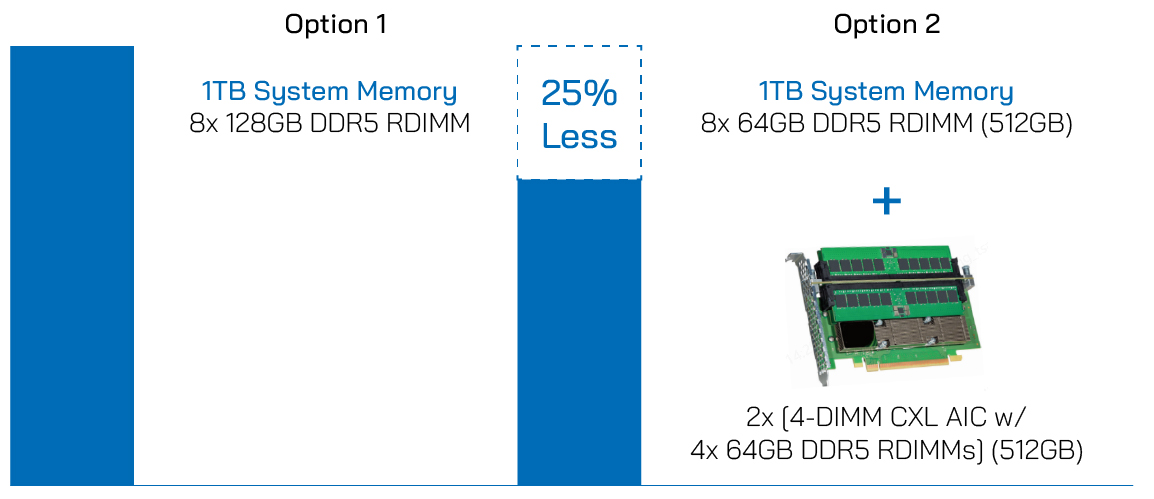
CXL allows memory expansion through PCIe slots, enabling systems to manage more data-intensive tasks. Take SCB-1953 as an example, it has original 8x DDR5 DIMM (1 DIMM per Channel). By adding 2x CXL AIC supporting 4x DIMMs per card, it doubles the system’s total memory capacity.

2. Reduced Memory Cost:
High-density DRAM modules, such as 256GB/128GB RDIMMs using 3DS or 32Gb-Density DRAM, tend to be expensive per GB. By switching high capacity RDIMM with four affordable 64/32GB RDIMMs with CXL memory expansion, total cost of ownership (TCO) can be reduced without compromising capacity.
CXL-AIC2-02

Option 2: 8x 64GB RDIMMs (native) + 8x 64GB RDIMMs (via CXL AIC)

Increased Memory Bandwidth:
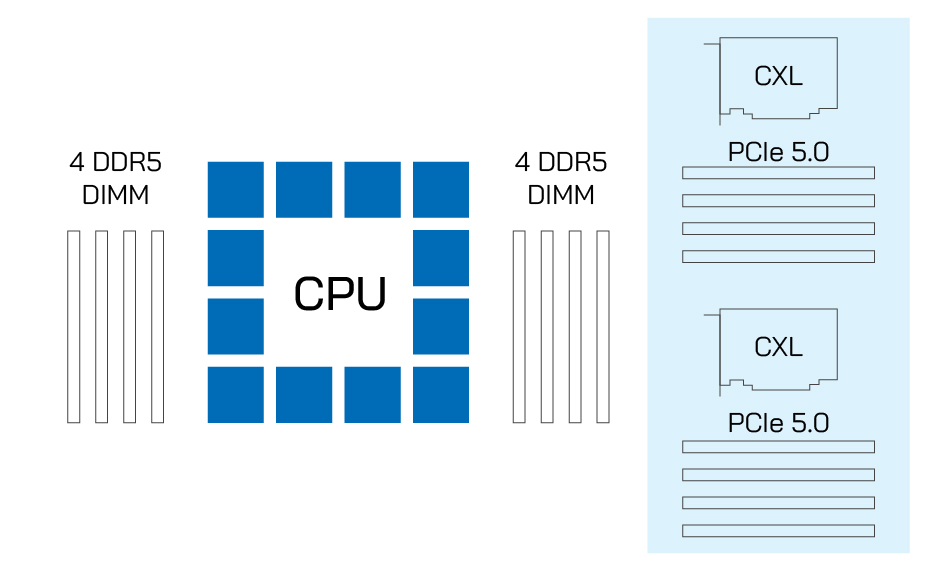
CXL enhances system memory bandwidth by introducing additional memory channels through CXL AICs. For example, in AEWIN’s SCB-1953, installing two CXL AICs adds up to 128 GB/s of extra memory bandwidth (64 GB/s per card), in addition to the native DDR5-6400 bandwidth from the CPU. This enhancement ensures real-time responsiveness for AI, analytics, and security workloads that demand high memory throughput.
CXL-AIC2-03

Original 8x memory channel-> 8x native memory channels + 4x CXL AIC memory channels through 2x 2-channel 4-DIMM AIC

Conclusion
As a transformative memory technology, CXL introduces a scalable and flexible memory tier that overcomes traditional limitations in memory channel and capacity. By integrating CXL, hardware platforms like AEWIN’s SCB-1953 can unlock exceptional memory scalability and flexibility to meet the growing demands of AI and networking workloads.

Related News

High-Density AI Infrastructure: Scaling Performance with Advanced Cooling Solutions
2026.09.02

High-Density AI Infrastructure: Scaling Performance with Advanced Cooling Solutions

As AI workloads demand greater processing power, data centers must achieve higher compute density and superior thermal efficiency while minimizing space and energy footprints. Integrating high-power CPUs and GPUs into compact server platforms makes advanced thermal management a critical factor in sustaining performance and optimizing infrastructure efficiency.

Building High-Performance Data Pipelines for Next-Generation AI Workloads
2026.08.25

Building High-Performance Data Pipelines for Next-Generation AI Workloads

AI infrastructure has traditionally focused on accelerating compute with powerful CPUs, GPUs, and AI accelerators. As AI workloads continue to process increasingly large and diverse datasets, compute alone is no longer sufficient. Next-generation AI infrastructure must extend from compute to data, featuring high-performance data pipelines that keep AI workloads running efficiently and seamlessly.

Empowering Agentic AI with High-Performance AI Servers
2026.08.18

Empowering Agentic AI with High-Performance AI Servers

Artificial Intelligence is rapidly evolving beyond content generation into autonomous decision-making. While Generative AI has transformed how organizations create text, images, and code, the next wave of AI innovation is driven by Agentic AI—intelligent systems capable of reasoning, planning, acting, and continuously improving with minimal human intervention. AI agents require significantly more computational resources than traditional AI applications, making modern high-performance servers the foundation for scalable, secure, and efficient Agentic AI infrastructure.

Inquiry Cart

total 0 items

Compare

total 0 items

Email Subscribe

Verification

Click the numbers from smallest to largest.

We use cookies to allow our website to work properly, personalize content and advertising, provide social media features and analyze traffic. We also share information about your use of our site with our social media, advertising and analytics partners

Manage Cookies

Privacy Settings

We use cookies to allow our website to work properly, personalize content and advertising, provide social media features and analyze traffic. We also share information about your use of our site with our social media, advertising and analytics partners

Privacy Policy

Manage Consent Settings

Essential Cookies

Accept All

The website cannot function without these cookies and you cannot switch them off on your system.

These cookies are typically set only in response to an action you perform (i.e. a service request), such as setting privacy preferences, logging in, or filling in a form.

You can set your browser to block or prompt you for these cookies, but this may prevent some site features from working.