

NVMe SSD Market Trends: Rising Capacities and Diversified Applications
Introduction
NVMe SSDs have transformed the storage industry with unprecedented speed and efficiency. Our previous blog introduced enterprise NVMe SSDs and their role in enhancing server performance. Today, we delve deeper into the evolving NVMe SSD market, focusing on the latest capacities and innovations driving their adoption across diverse applications.
Current Market Overview
The enterprise NVMe SSD market continues to thrive, offering solutions that cater to various demands. Capacities for single drive now range to over 30TB and more to enable high-density workloads.
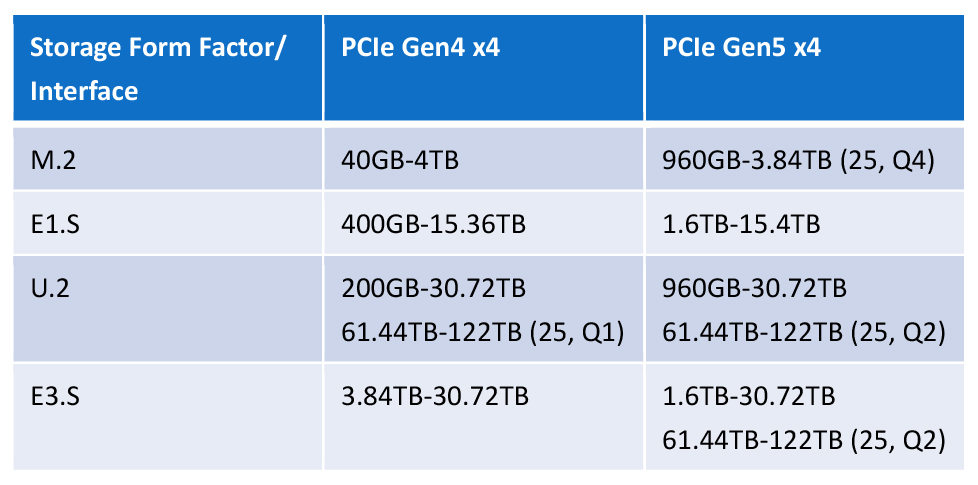
*Table1: The number is based on SSD vendors’ product roadmap till 2025.01 and will vary from time to time.
- Trend of storage form factor:
E1.S NVMe SSDs feature bigger power and better thermal management solution compared to M.2 drives and the market trend also reflects that the main product offering is focusing on E1.S based on the latest PCIe Gen5 interface while only few vendors offer PCIe5.0 M.2 SSDs with on hold schedule till the end of 2025.U.2 is under fast development as it becomes the main NVMe SSD in the market while nearly all vendors put resources on PCIe Gen5 SSD under E3.S form factor which aligns with the market trend that forward insights predicted in 2024 that E3.S will grow significantly from 2025.

- High Capacities (30TB+):
Large capacity SSDs with over 30TB represent a significant step forward in storage density, enabling organizations to store vast amounts of data in a smaller physical footprint. - PCIe Gen5 Support:
With speeds up to 32 GT/s per lane, PCIe Gen5 NVMe SSDs provide unparalleled throughput and low latency, redefining performance benchmarks across the storage industry.
Applications Across Industries
Enterprise NVMe SSDs are finding applications in numerous industries:
- Edge Computing:
In edge environments, where devices operate with limited space and power, NVMe SSDs deliver compact yet powerful storage solutions. They enable real-time data processing for IoT devices, remote monitoring systems, and smart city applications, ensuring minimal latency.
- AI and ML Workloads:
High-speed NVMe SSDs accelerate the training and inference stages of AI models by providing rapid access to large datasets. This is especially critical in fields like autonomous vehicles, natural language processing, and predictive analytics, where real-time decision-making is required.
- Backup and Disaster Recovery:
High-capacity NVMe SSDs play a crucial role in ensuring reliable backups and rapid recovery times for critical systems. With high-speed performance, organizations can perform frequent backups without disrupting operations, reducing the risk of downtime.
- Content Delivery Networks (CDNs):
NVMe SSDs improve the efficiency of CDNs by reducing latency and enhancing content retrieval speeds. This results in smoother streaming services, faster website loading times, and an overall improved user experience for end-users across the globe.
Conclusion
NVMe SSDs are at the forefront of the storage industry’s evolution. With capacities soaring beyond 30TB and innovations like PCIe Gen5, these storage solutions are setting new benchmarks in performance and efficiency. AEWIN remains committed to integrating cutting-edge storage technologies into our platforms, empowering our customers to excel in today’s data-driven landscape.