
The Development of Web 3.0
Background
In the past decades, there is significant changes in internet and the evolution keeps going forward. We have seen Web 1.0 and Web 2.0. What can we expect in Web 3.0? Let us take a look at the development of the internet and see how the latest technology influences our daily life and experience.
The Evolution of Web 3.0
Web 1.0 (1990-2004)
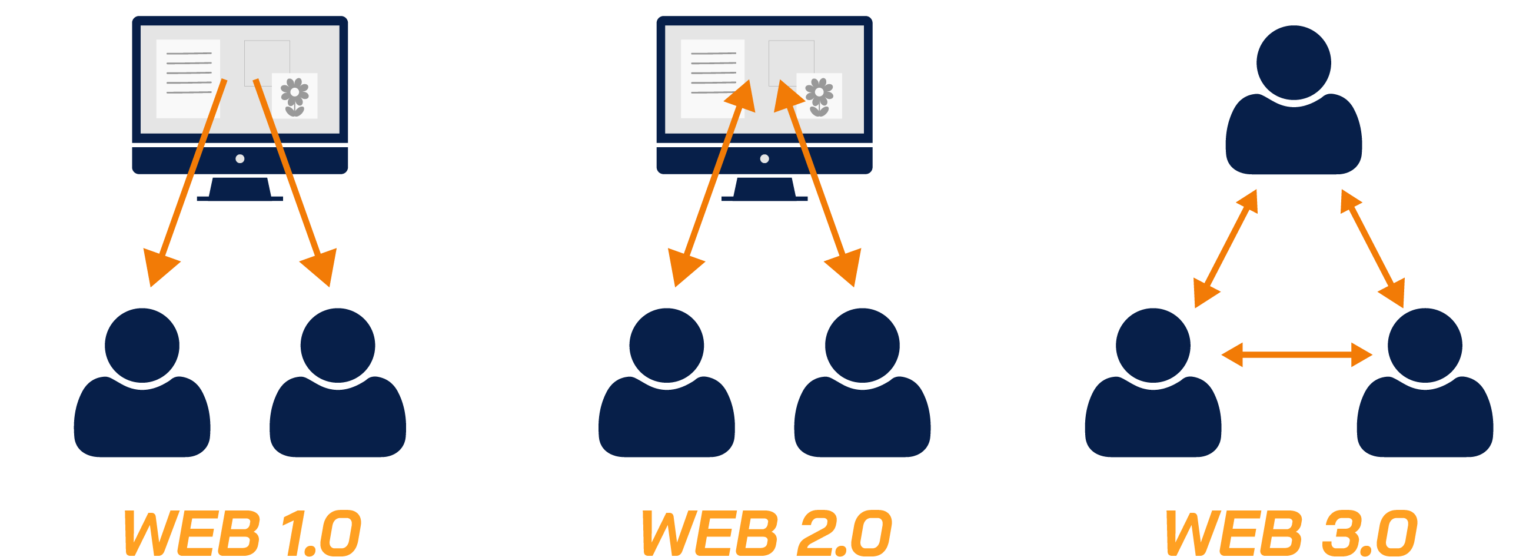
Before Web 1.0, people receive information from paper, publication, books, etc. Web 1.0 makes the information common by publishing the information on the internet for everyone to read. In Web 1.0, people can only search for information and no interaction is available.
Web 2.0 (2004-Now)
Due to the lack of interaction, people no longer satisfy with Web 1.0 and that leads to the coming of Web 2.0. Web 2.0 democratizes the information publication. That is, everyone can write their own content and leave message to others. This boosts the rises of the giants including Google, Facebook, YouTube, Instagram, TikTok, etc. who keep and maintain the vast databases.
During this period, users’ interactions in turn changed the way information is produced and obtained. However, the valuable private data and footprints are owned and controlled by several companies which make the content producers like tenant farmers. This pushes the evolution of internet toward Web 3.0.
Wen 3.0 (Now-Future)
Web 3.0 popularized the ownership of the content that is published on the internet. It provides an open, trusting, and permissionless networks based on blockchain technologies.
Let us figure out the features and new opportunities of Web 3.0 below.
Key Features of Web 3.0
Decentralization
Web 3.0 allows information to be retrieved based on its content, it can be kept in several location simultaneously, making it decentralized. Data ownership has been returned to everyone in a decentralized way in Web 3.0 instead of being used for profits by the internet giants in Web 2.0.
Permissionless
Participants will be able to interact directly without the need for a trusted intermediary or permission from another node or third party. In this way, no cookies acceptance is required when searching or browsing. Users’ private information would not be kept in the platform which enhances the privacy security.
AI (Artificial Intelligence) and ML (Machine Learning)
In web 3.0, computers can understand the information through semantic web ideas and natural language processing based on technologies of AI and ML. The accuracy of the algorithm would continue to improve and come up with the most suitable respond for users’ needs.
Connectivity
Along with the growth of IoT (Internet of Things), the connected devices will no longer limited to computers and smartphones. In Web 3.0, the internet can be accessible to everyone no matter what location it is and beyond the limitation of time.
With the features of Web 3.0 mentioned, new opportunities pomp up and more to come. Let us sneak a peek at some of the applications in Web 3.0 below.
New Opportunities
Virtual Assistant
Taking advantage of the success of Siri, the AI and natural language processing have developed to better understand human’s command. In Web 3.0, virtual assistance can work together with smart home to achieve better user experience.
NFT (Non-Fungible Token)
NFT is one of the most important applications of blockchain technology which may replace the traditional certificate of assets. NFT becomes the proof of capitalizing the user data, returning the “ownership” of personal data to the user.
Metaverse
The ultimate application of Web 3.0 could be the metaverse. With the collaboration of the latest technologies of 3D/AR/VR/AI/IoT/encryption/blockchain, a vivid virtual world of metaverse can be built on Web 3.0 for users to work, shop, live, social on it.
Conclusion
Web 3.0 is the new concept of internet which has features of decentralization, artificial intelligence, and permissionless to offer users better experience in searching information and individual services per users’ usage habit. To achieve Web 3.0, network with high throughputs and low latency is mandatory. AEWIN as a Network Appliances and Edge AI Servers provider will continue to provide the latest high-performance products to the market.