

2021.02.26

Internal data connectors

Share:

There are many cables inside a system. The most common are data and power. We’ll take a look at data cables today.
Internal-data-connectors01

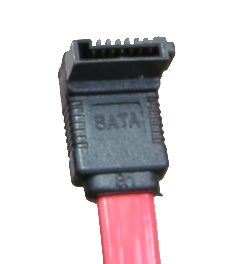
Picture originates from Wikipedia: https://zh.wikipedia.org/zh-tw/SATA

The most ubiquitous of data cable is the SATA cable. SATA was introduced in the year 2000 and has endured through continual updates of signaling to keep up with data transfer speeds of hard drives. Hard drive transfer speeds have stagnated, helping this standard to stick around for this long.
Internal-data-connectors02-768x608

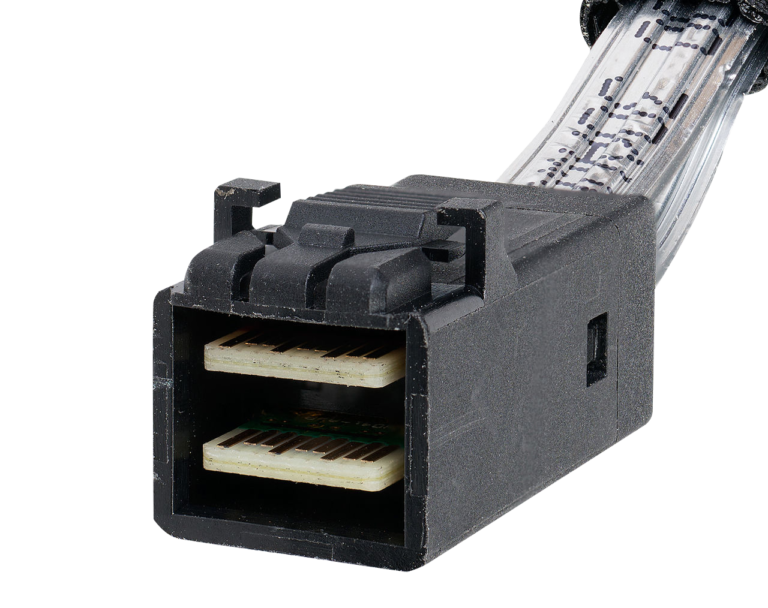
Picture originates from Wikipedia: https://www.wikidata.org/wiki/Q65036790

Enterprises have higher demand for reliability than SATA standard offers, so it introduced the SAS standard, which offers 2 data paths from host to drive in a single cable for added redundancy. The most common connectors on the host end is the MiniSAS HD. This connector supports up to 4 SAS drive per connector. The “HD” denotes high density as the current iteration has miniaturized from the previous standard.

This connector was introduced at a time where there is a trend of decoupling physical standards with electrical standards. It is widely used to carry PCIe Gen 3 x4 signals longer distances than PCB, giving additional flexibility of routing the signal to ease the placement of PCIe based peripherals inside the system.
Internal-data-connectors03

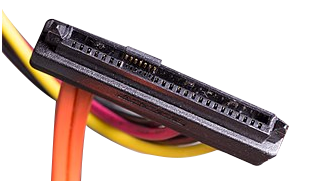
Picture originates from Wikipedia: https://en.wikipedia.org/wiki/Serial_Attached_SCSI

On the device end, an integrated power and data cable was designed for SAS with the aim to allow backward compatibility of interfacing with a SATA drive. A further evolution of this connector with clever usage of space allows it to carry additional pins to support 4x PCIe data lanes to interface with U.2 NVMe SSDs.
Internal-data-connectors04-1024x387

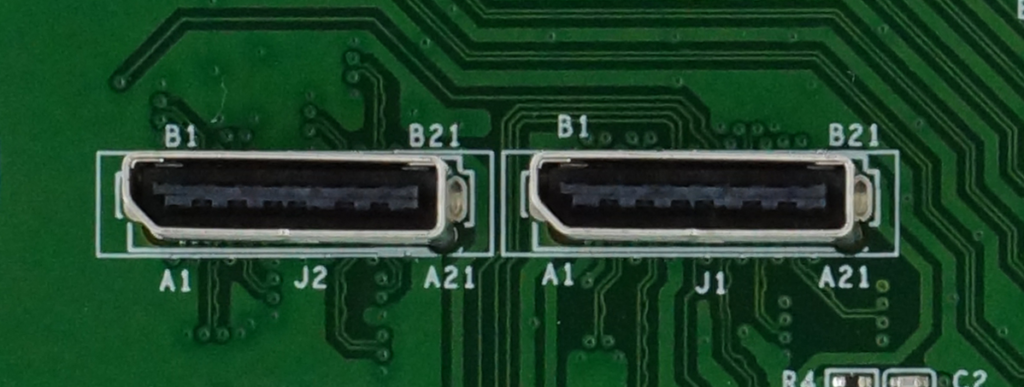
PCIe is one of the most common and important device-to-host communication bus standards. OCuLink is designed specifically to carry PCIe x4 signal. First it was designed for PCIe Gen 3 and has since been upgraded to support PCIe Gen 4. However, there is another contender that may be better suited for the job…
Internal-data-connectors05

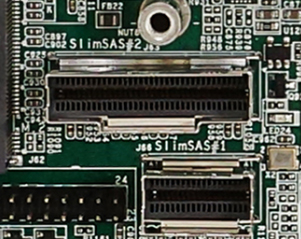
As the name implies, SlimSAS is designed for SAS. When the specification was released, it was designed in mind for the incoming SAS4 standard. Due to the signaling and electrical performance requirements, SlimSAS can be used to carry PCIe signal, up to Gen 4. It is available in 4 lane or 8 lane configurations, with the latter offering twice the lanesover OCulink and the previous MiniSAS HD standard. We see great potential with SlimSAS, where its flexibility and signal performance allows us to have better packaging and faster board to board connections.




Related News

Building AI-Ready Cybersecurity Infrastructure
2026.10.07

Building AI-Ready Cybersecurity Infrastructure

As cyber threats grow increasingly sophisticated, modern security infrastructure relies heavily on AI to analyze massive traffic volumes and accelerate real-time threat response. Powered by Intel Xeon 6 processors, AEWIN servers and network appliances deliver high-performance computing, efficient AI acceleration, and robust, hardware-based security required for demanding workloads across on-premises AI and AI-powered cybersecurity environments.

AEWIN 2025 Sustainability Report Highlights
2026.09.29

AEWIN 2025 Sustainability Report Highlights

At AEWIN, sustainability is integrated into corporate management with a focus on environmental responsibility, employee well-being, and social engagement. The 2025 Sustainability Report highlights the company’s continued efforts to improve resource efficiency, strengthen workplace health management, and foster a culture where sustainability becomes part of everyday actions.

Architecting Rack-Scale AI Infrastructure for the Neocloud Era
2026.09.24

Architecting Rack-Scale AI Infrastructure for the Neocloud Era

Generative and agentic AI applications, coupled with intensifying training and inference workloads, demand unprecedented compute throughput, memory, networking, and storage. Consequently, infrastructure can no longer be designed around isolated servers. The rise of specialized Neocloud providers further accelerates this shift toward rack-scale architecture, where compute, networking, and thermal management must converge to yield efficient, adaptable AI capacity.

Inquiry Cart

total 0 items

Compare

total 0 items

Email Subscribe

Verification

Click the numbers from smallest to largest.

We use cookies to allow our website to work properly, personalize content and advertising, provide social media features and analyze traffic. We also share information about your use of our site with our social media, advertising and analytics partners

Manage Cookies

Privacy Settings

We use cookies to allow our website to work properly, personalize content and advertising, provide social media features and analyze traffic. We also share information about your use of our site with our social media, advertising and analytics partners

Privacy Policy

Manage Consent Settings

Essential Cookies

Accept All

The website cannot function without these cookies and you cannot switch them off on your system.

These cookies are typically set only in response to an action you perform (i.e. a service request), such as setting privacy preferences, logging in, or filling in a form.

You can set your browser to block or prompt you for these cookies, but this may prevent some site features from working.

Function Cookies

These cookies enable the provision of enhanced functionality and personalised content, such as videos and live chats.

Settings can be made by us or by third-party providers whose services we have added to our pages.

If you do not allow these cookies, some or all of our features may not work properly.

Marketing Cookies

Marketing cookies are used to track visitors' journey through our website. The purpose is to display advertisements that are relevant or appealing to the individual user and are therefore more important to the publisher or third-party advertiser.

Targeting Cookies
These cookies are set through our site by advertising partners. These companies may use cookies to build a profile of your interests and show you relevant adverts on other sites. They only need to recognise your browser and device to work. If you do not allow these cookies, you will not experience targeted advertising across different websites.

Social Media Cookies
These cookies are set by a range of social media services that we have added to our site to enable you to share our content with your friends and networks. They can track your browser across other websites and build a profile of your interests. This may affect the content and messages you view when you visit other websites. If you do not allow these cookies, you may not be able to use or view these sharing tools.