

2024.05.16

Generative AI is Changing Our World

Share:

Introduction
As claimed by Nvidia CEO Jensen Huang in the latest GTC, the generative AI future is now. The first explosion took place in 2022 when ChatGPT get announced. Over 100 million users join the feast to experience the benefits of AI. After the duration of experimentation of various kinds of open models in 2023, here we are, entering the era of accelerated infrastructure in 2024.

What is Generative AI
Generative AI (Generative artificial intelligence, also known as GenAI or GAI) is AI capable of generating content. The procedure is divided by three parts including input information, model training and output.

  • Input Information
    Data input includes texts, images, videos, training models, molecular structures, and more. GPU can help to accelerate exploratory data analysis and speed up the preparation stage of data collection.
  • Model Training
    Generative model training includes supervised learning and unsupervised learning. Unsupervised learning is a crucial technique of generative AI models. Unlike supervised learning, where models are trained with labeled data (data with specific classifications), unsupervised training can deal with raw data lacking predefined categories or classifications.
  • Output
    After learning from the input training data with models, new content will be generated. The output includes texts, images, audios, videos, codes, recognized molecular structures, etc.

How is Generative AI Transforming Business
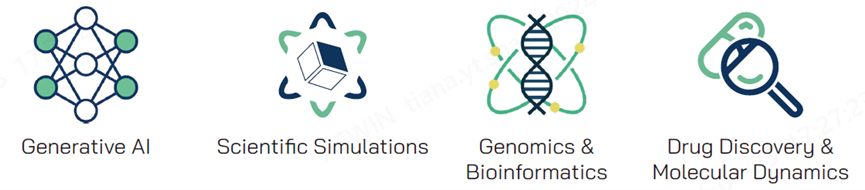
Generative AI benefits various kinds of applications including text generation, translation, coding, visual content creation, and life science. Among them, healthcare and life sciences are the largest data industry with 36% CAGR by 2025 according to research of RBC Capital Markets. It covers medical imaging, scientific simulations, genomics & bioinformatics, drug discovery, and digital healthcare.

  • Image Segmentation
    Generative AI models can be trained to segment specific structures within medical images, such as tumors or organs. With the enhancement of image segmentation, better efficiency and accuracy of AI model development can be achieved. Moreover, generative AI can be used to enhance the quality of medical images. The improved visualization assists doctors to perform better diagnosis.
  • Early Disease Detection
    Generative AI can analyze medical images like X-rays, MRIs, and CT scans to identify subtle abnormalities that might be missed by manual observation. To detect disease in early stage helps patient to get treatment before getting worse which may increase the cure rate accordingly.
  • Drug Discovery and Development
    Shorten the period of drug development can be accomplished through generative AI as GenAI can create new virtual molecular with desired properties for aiding in the identification of potential drug candidates. Furthermore, AI models can analyze vast datasets of existing drugs and patient information to predict potential ones with higher success rates.
  • Digital Healthcare
    Generative AI can analyze a patient’s specific genetic makeup, medical history, and other factors to create personalized treatment plans with better effectiveness and fewer side effects. In addition, the operational efficiency is improved by utilizing GenAI to generate reports, summarize medical records, and schedule appointments.
ALL_news_tech_blog_26A12_m9GeXdTDkS

Summary
Generative AI is changing our world. It benefits various kinds of applications while healthcare and life sciences are the largest data industry. From early disease detection to personalized treatment, enhanced efficiency and better effectiveness of diagnostic and treatment can be achieved with GenAI’s assistances.

Related News

Building Secure and Efficient On-Prem AI Infrastructure
2026.07.02

Building Secure and Efficient On-Prem AI Infrastructure

As Generative AI, AI Agents, and enterprise AI applications continue to expand, organizations are increasingly looking beyond the cloud to deploy AI closer to their data. Driven by growing concerns over data sovereignty, security, latency, and long-term operating costs, on-premises AI infrastructure has become a strategic choice for enterprises seeking greater control, performance, and scalability.

Rack-Scale AI Infrastructure: Maximizing Performance, Efficiency, and Scalability for the AI Era
2026.06.30

Rack-Scale AI Infrastructure: Maximizing Performance, Efficiency, and Scalability for the AI Era

Driven by the explosion of Gen AI, Agentic AI, and the massive datasets behind them, computing infrastructure is evolving from standalone servers to rack-scale architectures. Modern AI workloads require a tightly integrated combination of computing, networking, storage, and cooling solutions to deliver maximum performance and efficiency. Future-Ready AI Infrastructure has become the foundation for the AI Era.

Enhancing Network Resilience with AEWIN Gen4 LAN Bypass
2026.06.30

Enhancing Network Resilience with AEWIN Gen4 LAN Bypass

Traditional LAN bypass focuses on keeping traffic flowing when a system goes down, but modern deployments require greater flexibility to balance availability and security. AEWIN Gen4 LAN bypass builds on the Gen3 foundation by introducing enhanced traffic control mechanisms to enable network behavior to better align with real-world operational demands.

Inquiry Cart

total 0 items

Compare

total 0 items

Email Subscribe

Verification

Click the numbers from smallest to largest.

We use cookies to allow our website to work properly, personalize content and advertising, provide social media features and analyze traffic. We also share information about your use of our site with our social media, advertising and analytics partners

Manage Cookies

Privacy Settings

We use cookies to allow our website to work properly, personalize content and advertising, provide social media features and analyze traffic. We also share information about your use of our site with our social media, advertising and analytics partners

Privacy Policy

Manage Consent Settings

Essential Cookies

Accept All

The website cannot function without these cookies and you cannot switch them off on your system.

These cookies are typically set only in response to an action you perform (i.e. a service request), such as setting privacy preferences, logging in, or filling in a form.

You can set your browser to block or prompt you for these cookies, but this may prevent some site features from working.

Marketing Cookies

Marketing cookies are used to track visitors' journey through our website. The purpose is to display advertisements that are relevant or appealing to the individual user and are therefore more important to the publisher or third-party advertiser.

Targeting Cookies
These cookies are set through our site by advertising partners. These companies may use cookies to build a profile of your interests and show you relevant adverts on other sites. They only need to recognise your browser and device to work. If you do not allow these cookies, you will not experience targeted advertising across different websites.

Social Media Cookies
These cookies are set by a range of social media services that we have added to our site to enable you to share our content with your friends and networks. They can track your browser across other websites and build a profile of your interests. This may affect the content and messages you view when you visit other websites. If you do not allow these cookies, you may not be able to use or view these sharing tools.